By The OneTick Surveillance Team
The 2026 Trade Surveillance Benchmark asked surveillance and compliance professionals how they are approaching AI, data, digital assets, and regulation. Up to 241 people took part; bases vary by question.
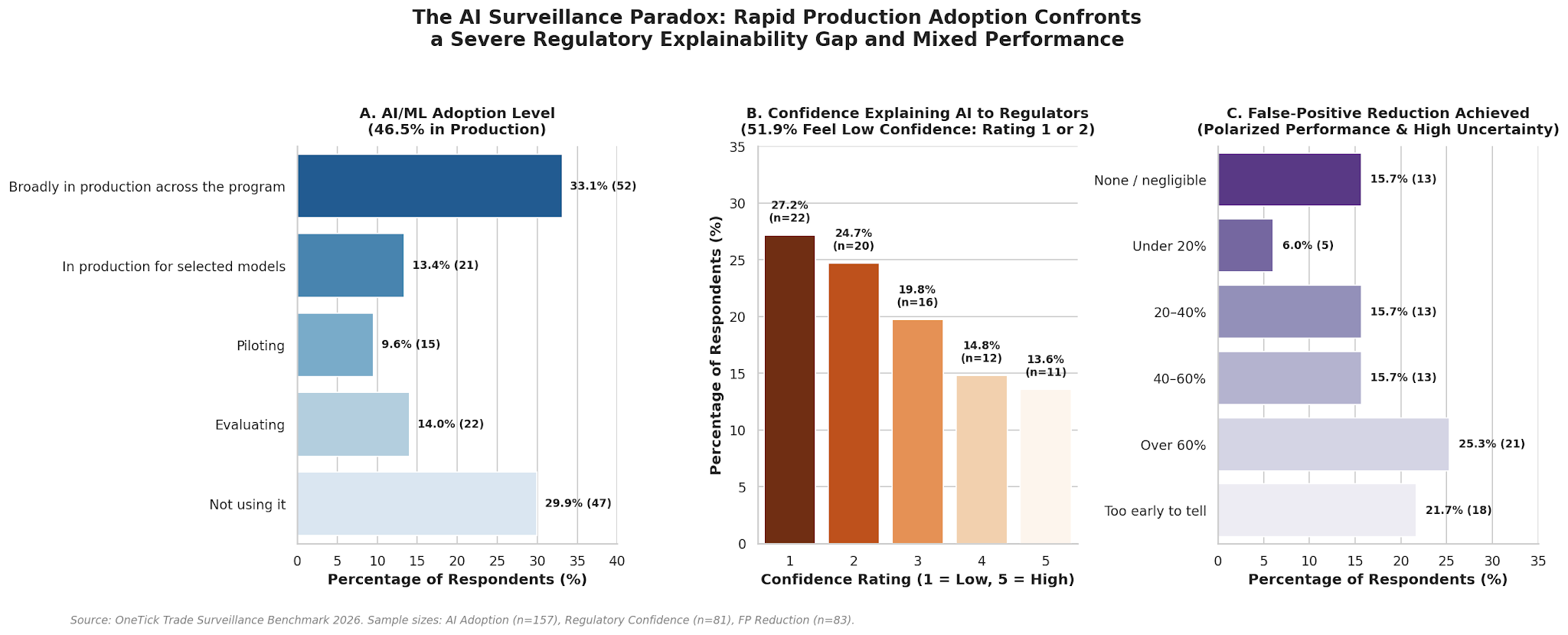
The data highlights varied perspectives with roughly a third of firms (33.1%) using AI/ML broadly in production, while 29.9% are not using it at all. Despite the anticipated value-add, reducing false positives is the least-cited benefit delivered so far. In fact, a critical weakness emerged with just over half of those asked rating their confidence in explaining an AI/ML alert to a regulator at 1 or 2 out of 5.
Beyond AI, data completeness and order-lifecycle reconstruction lead the data hurdles, coverage of tokenized assets trends incomplete, and cross-border obligations are expected to take the largest share of surveillance effort over the next 12 months.
Read on for more details on the major findings:
1. AI & Machine Learning in Production: A Highly Split Landscape
The data shows that the industry is starkly divided between active implementation and complete inaction: nearly half of respondents (46.5%) have AI/ML in production, while 29.9% are not using it at all.
-
Adoption Levels: 33.1% of respondents have AI broadly in production across their programs, and another 13.4% have it in production for selected models. However, 29.9% are still not using AI/ML at all, with the remainder either evaluating (14.0%) or piloting (9.6%).
-
Realized Value: For those 85 respondents using AI, when asked about realized value (multiple answers allowed), 27.1% reported “no measurable value” so far and 24.7% answered “N/A.” Where value was reported, the most-cited benefits are explainability/case narrative generation (21.2%) and analyst productivity/triage speed (18.8%). Despite anticipated added value for reducing false positives, this was the least-cited delivered benefit (10.6%, 9 of 85).
-
The False-Positive Debate: Asked directly about the size of any reduction in false-positives (n=83), 62.7% total reported some reduction, including 25.3% who saw more than 60%. But a high percentage said it is too early to tell (21.7%) or worse that there was negligible or no reduction at all (15.7%).
-
The Explainability Gap: Asked how confident they are explaining to a regulator why an AI/ML model flagged a trader (on a scale of 1 to 5), 51.9% of the 81 respondents asked rated their confidence at 1 or 2, a large weakness for auditability. Only 13.6% rated it 5.
- Scaling Barriers: When asked about which was the biggest barrier preventing compliance teams from scaling AI, respondents chose Cost (22.4%) and the shortage Skills/Talent (19.7%). Explainability to regulators (7.9%) and governance / validation were the least-cited barriers.
2. Data Challenges & Sourcing Postures
Data completeness, data coverage, and order-lifecycle reconstruction are the leading data hurdles. Firms remain divided on whether to build or buy surveillance analytics.
-
Top Data Hurdles: Data completeness/coverage (23.7%) and reconstructing the full order lifecycle (19.3%) are the two most painful data bottlenecks. These are followed closely by the cost of storage and compute (17.5%) and the difficulty of linking communications, trade, and market data (17.5%). Speed of access was the hurdle of least concern, chosen by only 7.9% of respondents.
-
The Sourcing Posture: No single approach dominates: 29.9% mostly build in-house, 23.4% mostly buy vendor platforms and 23.4% use a hybrid model, while a further 23.4% are actively re-evaluating their approach.
-
Cloud Migration Status: Most firms are in the cloud or heading there: 27.2% are already there, 20.4% have migrations in progress, and 13.6% plan to migrate within 12 months. 22.3% have no current plans, and 16.5% are restricted or not permitted to migrate workloads.
3. Tokenized Assets & 24/7 Digital Markets
As digital assets and tokenized securities move mainstream, surveillance frameworks are struggling to keep pace.
- Coverage Levels: Only 23.0% of firms have digital/tokenized assets fully integrated with traditional surveillance. Another 18.0% have partial coverage, while 38.0% currently do not cover them at all (though 15.0% plan to do so).
- The 24/7 Blind Spot: Respondents cited a lack of fit-for-purpose tooling (25.0%) as the single biggest threat in 24/7 digital markets. Other major concerns include 24/7 staffing and coverage (17.7%), cross-venue manipulation (16.7%), and on-chain/off-chain data gaps (16.7%).
- Who Detects Cross-Asset Manipulation? When market abuse spans both a tokenized asset and a traditional instrument, the industry is deeply uncertain where responsibility lies: 32.3% say it is a "shared responsibility / currently unclear", 23.7% believe it falls on the exchange/trading venue, 20.4% look to the custodian, and 16.1% look to the regulator.
4. Evolving Regulatory Pressures
Cross-border obligations lead the 12-month outlook, while views on the impact of regulatory divergence are split.
-
Divergence Impact: Views on regulatory divergence (such as differences between MAR, SEC, MiCAR and CIRO rules) are split. 33.0% say it is not a major issue and 20.5% find it manageable with their current setup, while 23.9% report significant duplication of cost and infrastructure and 22.7% say it is pushing them to consolidate onto a single platform.
-
The 12-Month Burden: Over the next year, cross-border/extraterritorial obligations (29.9%) are expected to take the largest share of effort, followed by digital-asset / MiCAR-style regimes (17.2%) and market abuse/MAR enforcement (16.1%). Accuracy, rule definitions, and off-channel expectations round out the field.
In Summary
Taken together, these results describe a market divided on AI rather than one moving in a single direction. Nearly half of respondents (46.5%) now run AI/ML broadly or selectively in production, yet more than half report low confidence explaining a model's flag to a regulator, and false-positive reduction outcomes remain sharply polarized. Nearly one third are not using AI at all.
The more widely shared challenges sit underneath AI. Data completeness and coverage and order-lifecycle reconstruction are the leading data hurdles, integration of tokenized assets is incomplete, and cross-border obligations are expected to take the largest share of effort over the next year. Firms that get these foundations right will be better placed to scale AI and to show regulators how it works.
OneTick Surveillance from KX is built for today’s landscape. It embeds AI/ML natively in a surveillance architecture designed for explainability, so every alert carries a transparent, regulator-ready rationale, analysts and compliance teams work from a single shared case view instead of reconciling across siloed tools, and false-positive performance can be measured and evidenced rather than assumed. Request a demo of OneTick Surveillance from KX today to see how your team can scale AI-driven detection without sacrificing the explainability, collaboration and operational efficiency that regulators and analysts depend on.
Best wishes,
The OneTick Surveillance Team